

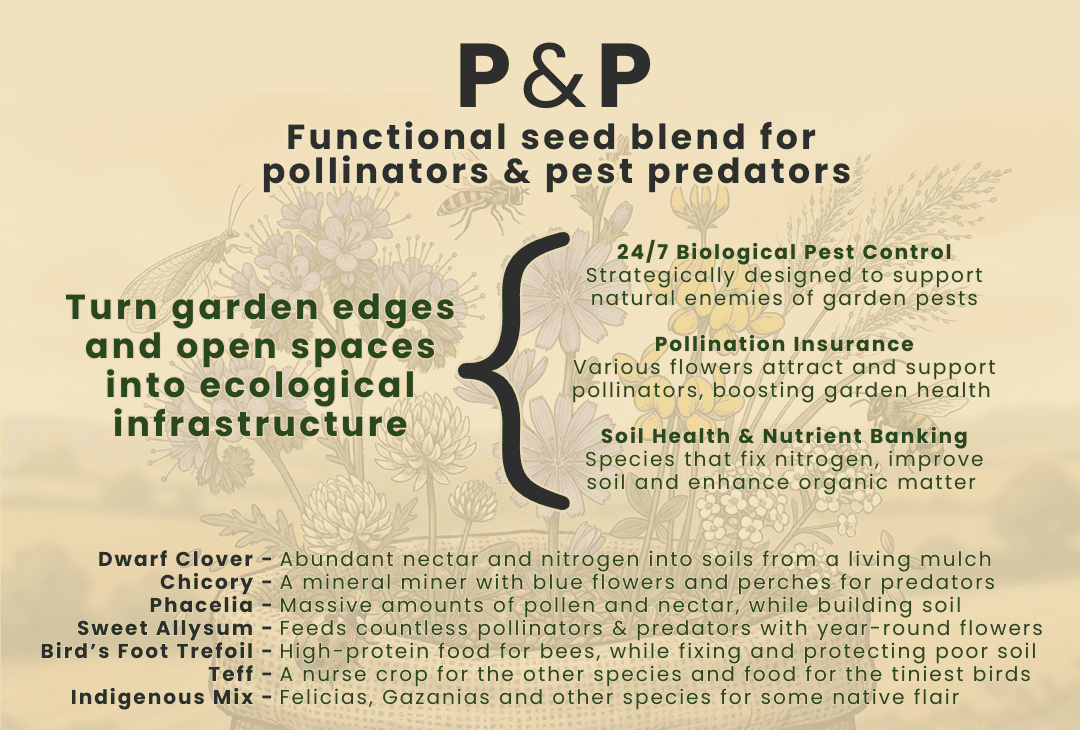
P&P (Pollinators & Predators)
Price range: R70,00 through R400,00
Functional seed blend specifically designed to attract and support pollinators and pest predators
Description
Turn edges and open spaces into ecological infrastructure with our P&P blend
Reduce reliance on reactive inputs, assists in lowering your chemical footprint and helps create a more resilient, more self-regulating farm or garden by creating attracting (and supporting) pests and predators with food and habitat.
24/7 Biological Pest Control
The mix is strategically designed to attract natural enemies of common vegetable pests. Instead of reacting to pest outbreaks with chemicals, you are establishing resident army of predators and parasites of pests.
Pollination Insurance
Even for self-pollinating herbs, increased pollinator activity boosts overall farm health. The various flowers in this mix attracts and supports pollinators ensuring that when you need their services, they are already there.
Soil Health & Nutrient Banking
It’s not just pretty flowers, it’s about building soil too. The various species help fix nitrogen, mine minerals from the subsoil and bring them to the surface, improve soil organic matter, and help in reducing both compaction and erosion.
| Species | Primary Benefits |
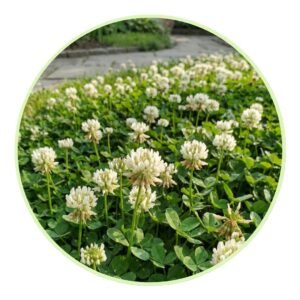
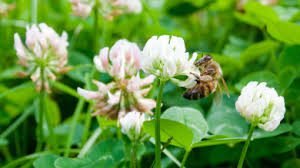
| Dwarf Micro Clover | Nitrogen fixer and provides abundant nectar for bees. Creates a “living mulch” that suppresses weeds and handles foot traffic. |
| Lobularia / Sweet Alyssum | Attracts and feeds many natural enemies. Blooms almost year-round in milder climates and serves as a trap crop for Brassica pests |
| Phacelia | Called Bee’s Bread, Phacelia produces massive amounts of high-quality pollen and nectar. Related to comfrey, its an excellent soil builder with a fine root system |
| Chicory | Mineral accumulator (pulls nutrients from subsoil) with a high drought tolerance. A deep taproot helps reduce soil compaction. Provides tall structural perches for predatory insects. |
| Bird’s-foot Trefoil / Lotus | Tannin-rich legume that fixes nitrogen in poor and acidic soils and provides high-protein forage for specialized native bees. Some research also suggests that it wards off soil-borne pathogens. |
| Teff | Quick ground cover and a nurse crop for the other species. Adds significant carbon/biomass and stabilizes soil against erosion. The tiny seeds are a source of food for the smallest birds. |
Ideal for orchards, awkward or under-utilised spaces in the garden or field, on edges, or incorporating into other cover crop blends.
All our legume seeds are pre-innoculated with rhizobium for nitrogen fixation.
Certified seeds from trusted suppliers.
Strategic Placement:
To maximize the effectiveness of your P&P strips, their placement must balance the biological range of the beneficial insects with the operational requirements of your farm machinery and irrigation.
The 10-Meter Rule
Most small beneficial insects, such as Parasitoid Wasps and Hoverflies, are most effective within 10 meters of their nectar source. If a vegetable bed is 50 meters away from a strip, the “patrol” density drops significantly.
Optimal Spacing: Establish a P& P strip every 20 to 30 meters across your field.
Strategic Positioning Options
A. Headland Strip (Perimeter Management)
Establish a permanent 2–3 meter wide strip along the unplanted turning areas at the ends of your rows and/or use the “awkward” unplanted areas in and around fields. These areas are often compacted and underutilized. Converting them into biodiversity zones prevents them from becoming “weed nurseries” and creates a barrier against pests migrating in from the surrounding veld.
B. The In-Field Inter-Row
For high-value crops, replace every 10th – 15th row of vegetables with a biodiversity strip. This places the predators directly in the “line of fire.” Aphids appearing in the center of a block will be discovered by hoverflies much faster than if the predators had to fly in from the perimeter.
C. The “Windward” Barrier
Identify the prevailing wind direction, then establish your primary, widest strips on the windward side of the fields. Small insects like wasps and lacewings are weak fliers. They often use wind currents to move. A windward strip allows them to “drift” naturally into your crop rows.
Implementation Guidelines for Growers
Site Preparation
Prepare the area at least 2 weeks before sowing. Allow weeds to germinate, then kill them with a shallow cultivation. This reduces competition for the slow-growing Clover and Lotus. Do not add high-nitrogen fertilizer. High nitrogen will cause the Teff and Phacelia to “bolt” and smother the beneficial legumes and herbs. The legumes have been inoculated and will provide nitrogen. A light application of Rock Phosphate or Bone Meal will support the deep root development.
Sowing Method: Broadcast and roll
This is the most common method for biodiversity strips. If broadcasting, increase the total rate by 20% to account for seed loss to birds and uneven germination. Because many of these seeds are tiny (especially Teff and Lobularia), the most critical step is rolling after sowing. This ensures proper seed-to-soil contact without burying the small seeds too deep.
Use sand when sowing
This mix contains a “heavy” seed (Phacelia) and “feather-weight” seeds (e.g. Teff, Lobularia). To ensure even distribution when hand-sowing or using a spinner, mix the seed with a carrier like slightly damp builder’s sand at a ratio of 3:1 (carrier to seed). This prevents the tiny seeds from settling at the bottom.
Timing
Can be sown from early spring to (early) Autumn. However, some moisture is required for establishment, thus match sowing times with rain if irrigation is not available.
Post-Sowing Management
Irrigation (First 21 Days)
For best results, keep the top 10 mm of soil moist but not wet. If irrigating, a light daily misting or brief dripline watering in the early morning or late afternoon is better than an intermittent heavy soak. An indicator plant is the phacelia. Once the Phacelia reaches about 10 cm in height, you can reduce irrigation.
The First “High Mow”
If you see broadleaf weeds (like Khakibos or Pigweed) overtaking the strip in the first 6 weeks. Set your mower to its highest setting (roughly 15–20 cm), or brushcut at this height. This will help recue these these weeds, without slowing down the low-growing Clover, Lotus, and Lobularia beneath. If labour is available, you can alternatively hand weed persistent problem plants.
Other guidelines:
Frost Awareness
If you experience frost, your Lobularia and Phacelia might be hit by early winter frosts in June. However, the Chicory and Clover roots will survive and re-emerge stronger in spring.
Staggered Cutting
Every 3 months, mow only half the strip. This keeps flowers available while forcing predators to move into your crop rows. Mow the strip to a height of 10-15cm. This prunes biomass and often triggers a fresh round of blooms. Leave the litter as mulch.
Winter Cover
During the dry winter (June–July), the Chicory taproots will be working deep in the soil. Leave the dried stalks standing if possible; they provide over-wintering “hotels” for beneficial solitary bees and predatory insects
No-Till Maintenance
Avoid digging up the strip. Let the Chicory and Clover roots build permanent “highways” for soil biology.
Zero-Spray Zone
Even organic sprays like Neem oil should be avoided in these strips to protect the delicate Parasitoid Wasps.
| Beneficial recruits | Attracted by | Primary Prey | Ecology |
| Hoverflies / Syrphids | Lobularia, Phacelia | Aphids, Thrips, Mealybugs | Adults are the “second most important pollinators” after honeybees. The larvae are voracious aphid killers, sucking them dry by the dozen. Lobularia is the gold standard for providing the adults with easy nectar access, the shallow florets accommodating their short mouthparts. Vital for protecting brassicas (broccoli/kale) from the grey cabbage aphid and citrus from woolly aphids, amongst other crops. Attracted to the flowers in the P&P strips, the adults will patrol nearby fields for aphids that their larvae can eat. |
| Parasitoid Wasps (e.g. Aphidius & Trichogramma spp.) | Lobularia, Chicory, White Clover | Cabbage Loopers, Diamondback Moths, Aphids | Tiny wasps that lay their eggs inside pests. The emerging larvae kill the host from within. They love the high-protein pollen of White Clover and the “floral perches” provided by Chicory. The primary natural defense against the Diamondback Moth (Plutella xylostella). As these wasps are very small and easily dehydrated, the Teff and dwarf clover helps provide a cool, humid “micro-climate” at ground level where they can rest during the heat of the day. |
| Lacewings | Phacelia, Teff (for shelter), Lobularia | Spider Mites, Whitefly, Scale (crawlers) | Both the adults and larvae are very effective generalist predators. The larvae of some species carry the carcasses of their prey on their backs as camouflage – Surely a frightening sight if you’re a pest in their path |
| Ladybirds / Lady bugs | White Clover, Lotus, Phacelia | Aphids, Psylla, Red Spider Mite, Mealybugs | Both adults and larvae are voracious predators of pests. A single ladybird can eat over 5000 aphids in its lifetime. |
| Assassin Bugs (Reduviidae) | Chicory (stalks), Lotus | Stinkbugs, Bagrada Bugs, Caterpillars | “Wait-and-prey” hunters. They use tall stalks like that of Chicory as vantage points to ambush larger pests. Assasin bugs require structural diversity. The woody, tall stems of second-year Chicory are perfect for them, as well as the tufts of teff and Phacelia flower-spikes. They are one of the few predators that will tackle Stinkbugs and the Bagrada Bug. |
| Minute Pirate Bugs (Orius spp.) | Phacelia, White Clover | Thrips, Maize Earworm eggs | Very small but very aggressive. They are often the first to arrive when thrips appear in herb crops. |
| Tachinid Flies | Lobularia, Chicory | Armyworms, Grasshoppers, Cutworms | Often mistaken for houseflies, but they parasitise the pests bigger than what the wasps can handle. |
| Ground beetles (Carabids) | Dwarf clover, Lotus, Teff | Slugs, Snails, and Cutworm | Nocturnal predators targeting various pests. Because they hunt at night, they need a “living mulch” to hide under during the day. The Clover and Lotus blanket provides this beetle shelter, so that they can do their night patrol in your fields. |
Additional information
| Weight | N/A |
|---|---|
| Dimensions | N/A |
| Square metres | 15, 50, 250 |
Related products
-

Dwarf Micro Clover
Price range: R35,00 through R220,00Select options This product has multiple variants. The options may be chosen on the product page -
Clovermix Cover Crop
Price range: R35,00 through R245,00Select options This product has multiple variants. The options may be chosen on the product page
Reviews
There are no reviews yet.